 Coupons
Most people find out their garage door springs were at the end of their life the same way: a bang like a gunshot from the garage, and a door that will not open.
It does not have to go that way. Springs are one of the few parts of your house with a predictable service life, and you can estimate yours in about a minute of math. Here is how they are actually rated, how to tell where yours stand, and why September is a better month to deal with it than January.
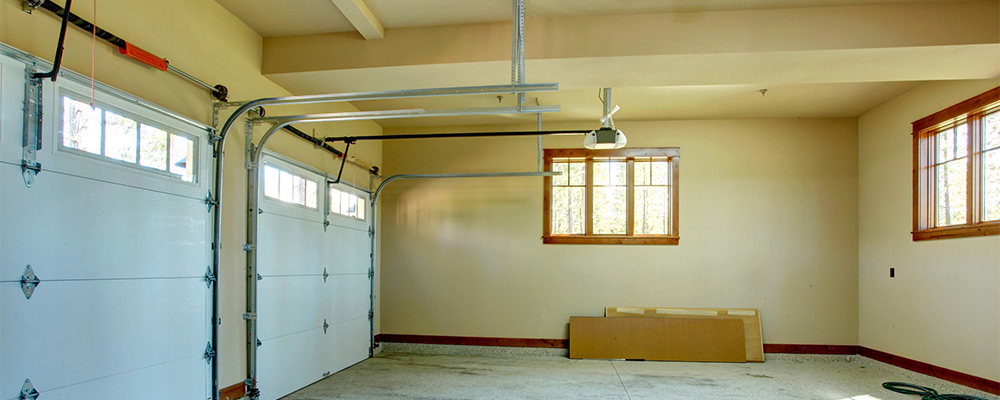 Springs Are Rated in Cycles, Not Years
This is the part almost nobody knows.
A garage door spring does not come with a warranty measured in years. It comes with a cycle rating. One cycle is one full open and one full close. That is it.
If you want the engineering behind it, the Door and Access Systems Manufacturers Association publishes a technical data sheet on the factors that determine spring cycle life, available in DASMA’s technical data sheet library as TDS 190. The short version is that cycle life comes down to wire diameter, coil diameter, the number of active coils, and how far the spring deflect
So the honest answer to “how long do springs last” is: it depends entirely on how much you use your door.
Do the math on your own house
Count how many times your garage door goes up and down in a normal day. Not what you assume. What actually happens.
| Cycles per day | Cycles per year | Life of a 10,000-cycle spring |
|---|---|---|
| 2 | 730 | About 13 years |
| 3 | 1,095 | About 9 years |
| 4 | 1,460 | About 7 years |
| 6 | 2,190 | About 4.5 years |
| 8 | 2,920 | About 3.5 years |
Most Indiana households land higher on this table than they expect. If your garage is the door everyone actually uses instead of the front door, and you have two drivers plus kids, plus a dog walk, plus taking the trash out, you are at six or eight cycles a day without noticing.
That is why two houses on the same street with identical doors installed the same year can be five years apart on spring replacement.
What Shortens Spring Life in Indiana
Cycle count is the main variable. It is not the only one.
Cold. Steel contracts and becomes more brittle in low temperatures. A spring that is already near the end of its cycle life is far more likely to fail on a cold morning than a mild one. This is not superstition, it is why our phones ring the way they do in January. An unheated garage subjects the spring to the full tension range while it is cold-stressed, every single time the door opens.
Rust and moisture. Indiana humidity in summer and salt-laden slush in winter both attack spring steel. Rust increases friction between the coils, which wears the metal faster than the cycle rating assumes.
Weight the springs were never sized for. This one surprises people. If you added insulation panels, decorative carriage hardware, or windows to an existing door, you made the door heavier without recalculating the springs. DASMA specifically warns that added weight causes unbalanced and irregular operation. The springs are now working harder than they were engineered to, and they will not reach their rated cycles.
A door that is out of balance for any other reason. Dragging rollers, a bent track, or a door binding in the opening all mean the springs are carrying load they should not be.
Poor installation. A spring sized for the wrong door weight, or the wrong wire diameter for the application, will fail early no matter what the label says.
 How to Tell Where Your Springs Stand
You cannot read a cycle rating off most residential springs. It is not printed on them. The rating is determined by wire diameter, coil diameter, coil count, and length, and it takes measurement to calculate.
What you can do yourself, safely, is watch for these:
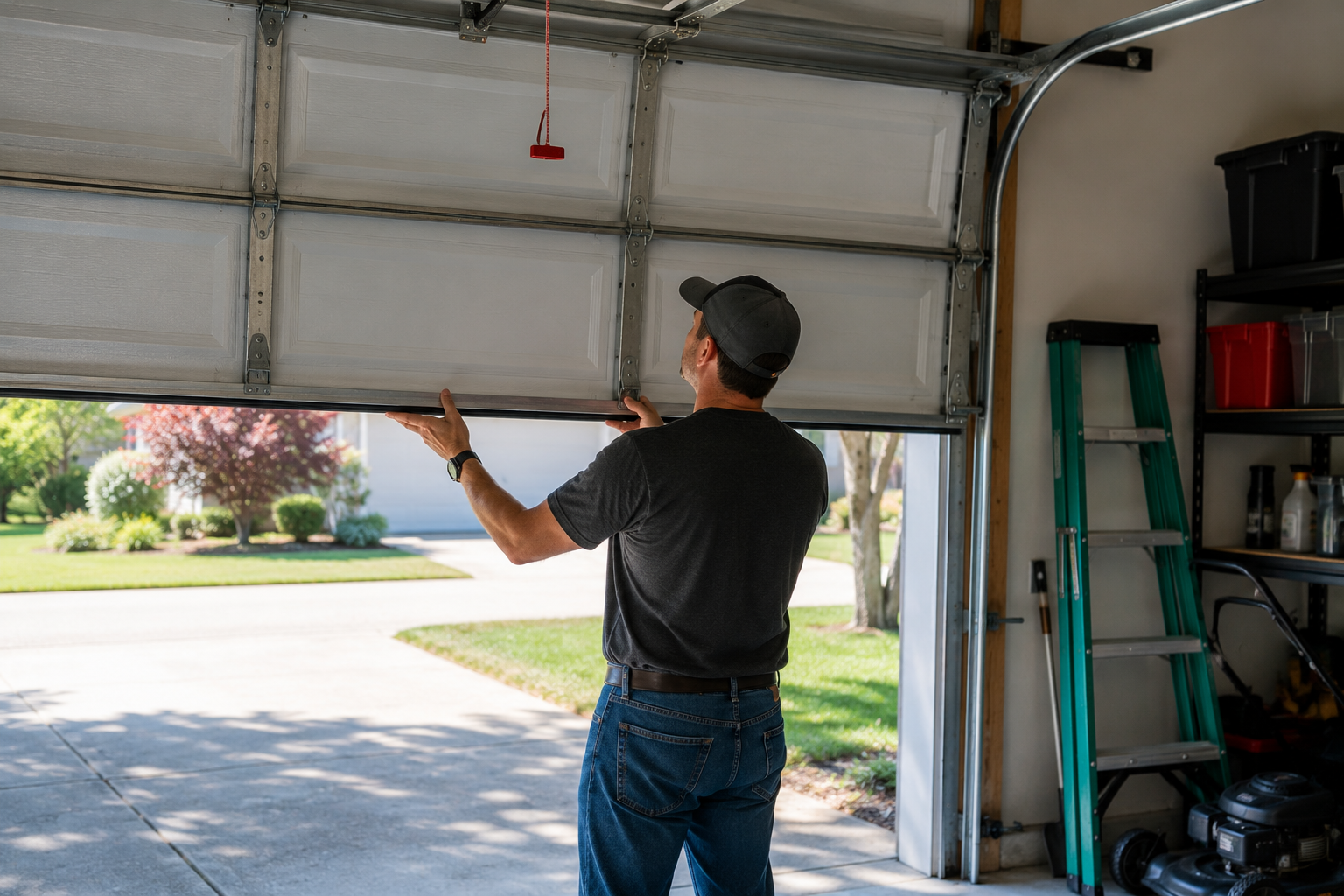
The door feels heavy. Pull the emergency release cord to disconnect the opener, then lift the door by hand to about waist height and let go. A properly balanced door stays roughly where you left it. If it drops, the springs have lost tension. If it feels like you are lifting the whole weight of the door, they have lost a lot of it.
The opener is working harder. Straining, groaning, or a door that lifts a few inches and stops usually means the opener is fighting weight the springs should be carrying. People often replace the opener at this point. The opener was rarely the problem.
The door opens unevenly or looks crooked in the opening.
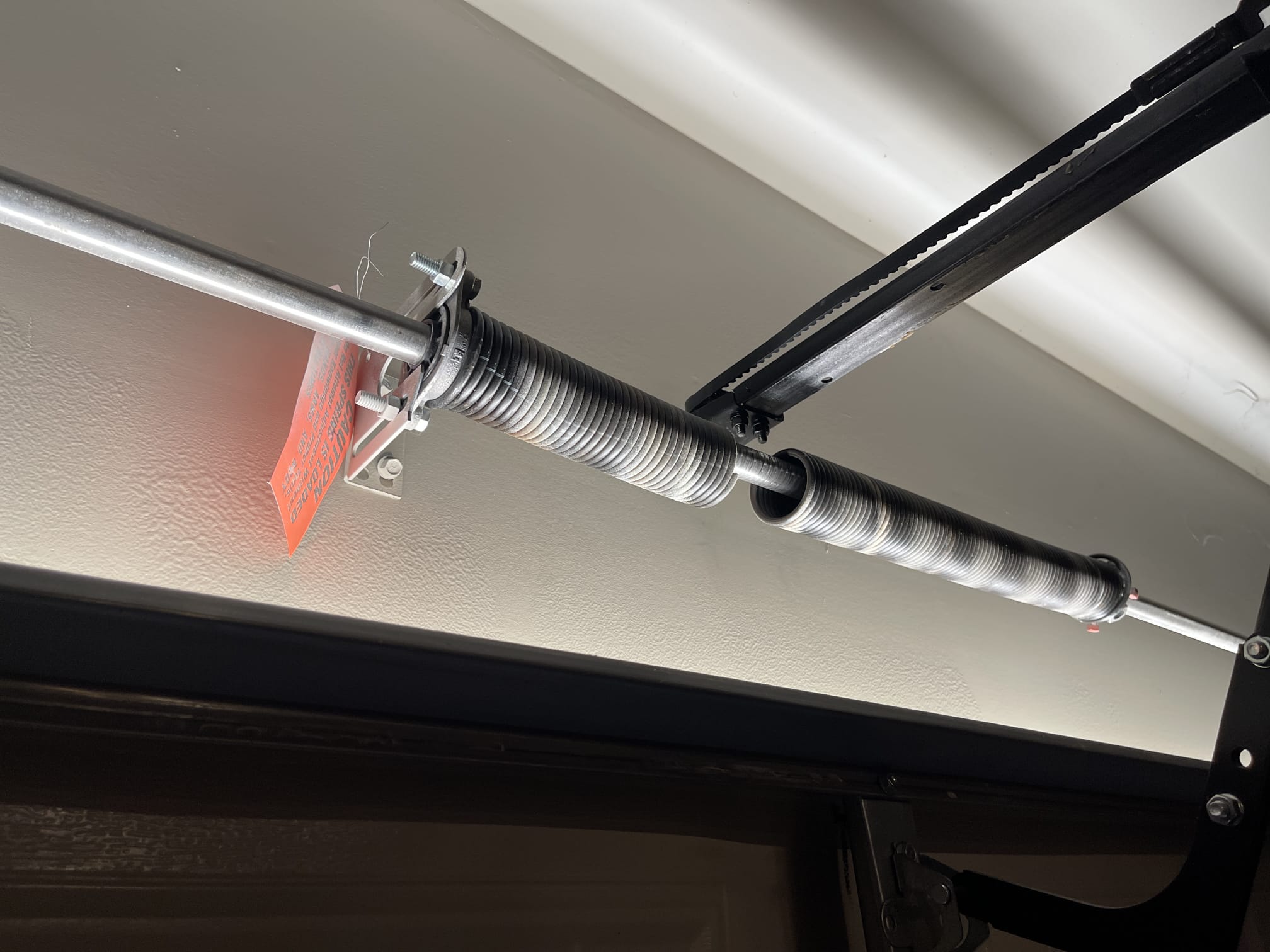
Visible gap in the coil. Look at the spring above the closed door. A torsion spring with a separation of an inch or two in the coil is already broken.
Rust, or coils that look stretched or uneven.
Cables hanging loose or unwinding off the drums.
A loud bang with no obvious cause. Sometimes people hear it and find nothing wrong, because the door was open at the time. It will not open the next morning.
If you see any of these, stop using the door and call. Our post on what to do if your garage door springs break walks through the immediate steps.
Do not try to adjust or replace springs yourself. A torsion spring holds enough stored energy to cause severe injury. We wrote a whole post on that question: is it safe to repair your own garage door spring. Short answer, no.
Should You Replace One Spring or Both?
If your door has two springs and one breaks, replace both.
The reasoning is simple. Both springs were installed at the same time and have taken the same number of cycles. The second one is not fresh, it is the same age as the one that just failed and it is next. Replacing one means paying for a service call now and another one within months, plus the risk of a mismatched pair pulling the door out of balance in the meantime.
The labor is already onsite. The second spring is the cheaper part of that visit.
Is a Higher-Cycle Spring Worth It?
Sometimes, and it depends on your usage.
A higher-cycle spring uses a thicker wire, a larger coil diameter, and more coils to spread the same stored force across more material. Going from a 10,000-cycle spring to a 20,000-cycle spring roughly doubles the expected service life.
It usually makes sense if:
- Your garage door is the household’s main entrance and you are running six or more cycles a day
- You have already replaced springs once and are not eager to do it again soon
- Your door is heavy, insulated, or oversized
- You plan to stay in the house long term
It usually does not make sense if:
- Your door is near the end of its own life and you expect to replace the whole system before the springs run out
- You are at two or three cycles a day, where a standard spring already gives you a decade
A higher-cycle spring does not require a different opener. Correctly calculated, a properly balanced door actually puts less strain on the opener, not more. It does require the torque to be recalculated for your specific door weight, which is measurement work, not a parts swap.
Ask your technician what your current springs are rated for and what the upgrade would cost while they are already there. It is a much better conversation to have during a planned visit than during an emergency call.
Why September Is the Month to Handle This
Two reasons.
Cold weather is when tired springs fail. Brittle steel plus full tension plus a spring already near its cycle limit is the combination that produces the January phone call. Dealing with it in September means dealing with it on your schedule.
A planned visit is a different appointment than an emergency one. When a spring breaks, the door is stuck, your car may be stuck inside it, and you are calling for same-day service. When you schedule an inspection, a technician measures the door, checks balance, inspects cables and drums, and tells you what you have left. If the springs are fine, you know. If they are not, you choose the timing.
We covered the broader seasonal prep in our recent post on garage door maintenance for winter. Springs are the single item on that list most worth getting ahead of.
 Get Your Springs Checked
Garage Doors of Indianapolis has been serving Centra
l Indiana homeowners since 1979. Our technicians can measure your springs, calculate what they are actually rated for, check your door’s balance, and tell you honestly how much life you have left.
If they are fine, we will tell you that. If they are close, you get to decide when to replace them instead of finding out on a 20-degree morning.
Call 317-860-0806 to schedule a spring inspection, or learn more about our garage door repair services and maintenance services.
Frequently AskedQuestions
How long do garage door springs last? Standard residential springs are rated at about 10,000 cycles, where one cycle is a full open and close. At four cycles a day that works out to roughly seven years. At two cycles a day it can be over a decade. Usage, not age, is what determines it.
What is a garage door spring cycle? One complete opening and closing of the door. Cycle ratings, not years, are how springs are specified
Why do garage door springs always break in winter? Steel becomes more brittle as temperatures drop, and an unheated garage exposes the spring to that stress through its full tension range every time the door opens. Cold does not usually cause the wear, it reveals wear that was alreadythere.
Should I replace both springs if only one broke? Yes, on a two-spring door. Both springs have the same age and cycle count, so the second is likely to fail soon after. Replacing both on one visit avoids a second service call and keeps the door balanced.
Can I tell what my springs are rated for by looking at them? Usually not. Most residential springs are not labeled. The rating comes from wire diameter, coil diameter, coil count, and length, which a technician measures.
Can I replace a garage door spring myself? No. Torsion springs hold enough stored tension to cause serious injury or death. This is work for a trained technician with the proper winding bars.